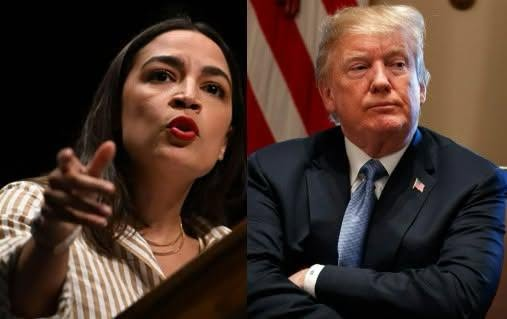
At a Michigan Rally, Alexandria Ocasio-Cortez Warns Supporters About the Power of Political Narratives, Trust, and the Battle Over America’s Future
In American politics, few debates are as powerful as the battle over reality itself.
Every election cycle brings disagreements over policies, priorities, and the direction of the country. But beneath those arguments is a deeper question that often determines how voters see the world:
What version of America do people believe is true?
That question took center stage when Representative Alexandria Ocasio-Cortez delivered a fiery speech in Michigan, criticizing former President Donald Trump’s continued focus on the 2020 election and accusing him of creating a political narrative disconnected from reality.
Speaking during a rally supporting Senate candidate Abdul El-Sayed, Ocasio-Cortez argued that Trump’s political strategy relies on presenting supporters with a version of America shaped by fear, anger, and grievance rather than facts and shared experiences.
According to Ocasio-Cortez, the issue extends beyond one election or one political dispute.
She believes it represents a larger struggle over how Americans understand their country, their communities, and each other.
“We saw it just a few nights ago in President Trump’s primetime address,” she told the crowd. “Trump spent most of his speech rehashing the same big old tired lie about the 2020 election.”
Then she delivered the line that quickly drew attention:
“The man cannot stand the truth, so he has to manufacture a fiction where he is popular.”
Her message was clear: she believes Trump’s political influence depends on convincing people to accept a version of events that she argues does not match reality.
The Continuing Debate Over the 2020 Election
The 2020 presidential election remains one of the most politically divisive moments in recent American history.
Donald Trump has continued to challenge the outcome of that election, claiming that irregularities affected the result.
Election officials, courts, and numerous reviews have repeatedly found no evidence of widespread fraud that would have changed the outcome.
For Trump’s supporters, however, the issue remains a symbol of broader concerns about trust in government institutions, election procedures, and political leadership.
For critics like Ocasio-Cortez, continuing to revisit the election years later represents something different.
They argue that repeatedly questioning a settled result risks damaging public confidence in democratic systems.
During her remarks in Michigan, Ocasio-Cortez framed the issue as part of a larger political story.
She argued that Trump is not simply discussing one election.
Instead, she said he is creating a broader narrative about America itself.
“A Fairy Tale About America”
One of the most memorable parts of Ocasio-Cortez’s speech was her description of what she called a fictional version of the country.
“A fairy tale about America where the majority of us fear our neighbors, where most of us think that this country is so much smaller than it actually is,” she said.
Her argument was that Americans should reject narratives built around division and fear.
She suggested that many people’s everyday experiences do not match the darker picture often presented in political messaging.
Millions of Americans live, work, and interact with people from different backgrounds every day.
They share communities.
They share workplaces.
They share common challenges.
According to Ocasio-Cortez, the political conversation should focus on those shared realities rather than encouraging people to see one another as enemies.
“But we have to remember that it is just that,” she said. “Fiction, fairy tales, a myth, a story, a lie.”
The Power of Political Stories
Political movements have always relied on storytelling.
Every major political figure creates a vision of the country they want voters to believe in.
Some leaders emphasize opportunity.
Others emphasize security.
Some focus on economic struggles.
Others focus on cultural change.
The most successful political messages often connect with people’s emotions as much as their opinions.
Ocasio-Cortez’s criticism is that Trump’s message relies heavily on nostalgia, anger, and a belief that America has been taken away from ordinary citizens.
Trump’s supporters, however, often argue that he is responding to real concerns about institutions, immigration, economic uncertainty, and government accountability.
The disagreement is not only about policies.
It is about how people interpret the country around them.
Why the Debate Goes Beyond One Election
For Ocasio-Cortez, the 2020 election dispute represents a larger issue.
She argues that democracy depends not only on voting, but also on accepting legitimate outcomes.
Her concern is that if people lose faith in elections whenever their preferred candidate loses, the entire system becomes vulnerable.
She warned supporters that the country must be prepared for future challenges involving elections and public trust.
Her message was that defending democracy requires more than participating in elections.
It requires believing that facts matter.
It requires respecting institutions.
It requires recognizing reality even when the truth is uncomfortable.
Trump’s Relationship With His Supporters
One reason Trump remains such a powerful political figure is the loyalty of his supporters.
His supporters often view him as someone willing to challenge institutions they believe have ignored them.
They see his criticism of government, media, and political leaders as evidence that he is fighting for ordinary Americans.
His critics see the same behavior differently.
They argue that Trump’s attacks on institutions weaken public confidence and deepen division.
The disagreement reveals one of the central conflicts in modern American politics:
Is Trump exposing problems that others ignore?
Or is he creating problems by challenging trust in institutions?
Millions of voters answer that question differently.
The Battle Over America’s Identity
At the heart of Ocasio-Cortez’s speech was a question larger than any single election:
What kind of country is America?
Different political groups often describe completely different versions of the nation.
One side may see a country facing decline and needing dramatic change.
Another may see a country with challenges but also enormous progress and opportunity.
Both sides believe their vision represents the truth.
That is why political debates can become so emotional.
People are not only arguing over policies.
They are arguing over identity.
They are arguing over what America has been, what it is now, and what it should become.
Why Facts and Trust Matter
Democracy depends on disagreement.
A healthy society allows people to debate ideas, challenge leaders, and demand accountability.
But disagreement becomes dangerous when people cannot agree on basic facts.
That is the concern expressed by many critics of political misinformation.
They argue that democracy requires a shared foundation of reality.
Without that foundation, every debate becomes impossible because people are starting from completely different understandings of events.
Ocasio-Cortez’s message was ultimately about that foundation.
She urged Americans not to accept political narratives simply because they are emotionally powerful.
She encouraged people to look closely at evidence and question claims from all sides.
A Warning About the Future of American Politics
As the country moves toward future elections, the fight over information and trust will likely continue.
Candidates will continue presenting different visions of America.
Voters will continue deciding which stories they believe.
The challenge, according to Ocasio-Cortez, is making sure those decisions are based on reality rather than fear.
Her warning was that Americans must recognize when political messages attempt to replace facts with fantasy.
Whether voters agree with her criticism of Trump or not, her speech highlighted an undeniable reality of modern politics:
The battle for America’s future is also a battle over how Americans understand the present.

The Final Message: Choosing Reality Over Division
Alexandria Ocasio-Cortez’s remarks were not simply about one speech or one politician.
They were about a larger question facing the country:
What happens when people no longer agree on the world they live in?
Her answer was clear.
Americans must protect truth, reject fear-driven narratives, and remember the connections that exist beyond political differences.
The future of democracy, she argued, depends on citizens choosing reality over division.
Because before a nation can solve its problems, its people must first agree on what is real.
And that may be the most important debate of all.