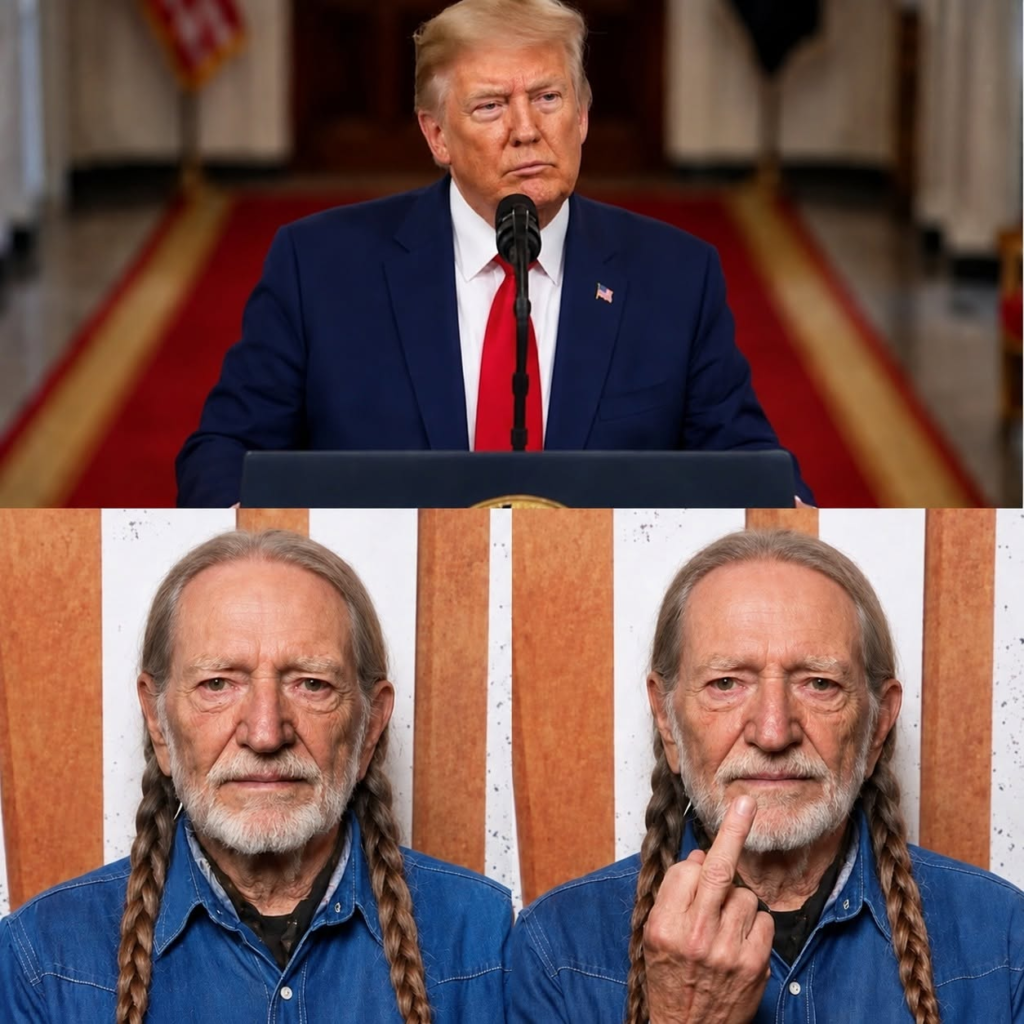
A Moment That Begins as Truth and Becomes Performance
In the modern media landscape, some stories arrive already fully dramatized. A celebrity appears. A political figure is referenced. Documents are said to be revealed. A moment is described as “devastating.” And before any verification occurs, the narrative has already taken emotional shape in the public imagination.
The circulating story involving Willie Nelson, Donald Trump, and a supposed live television “revelation” about historical academic testing follows a familiar viral structure. It blends cultural familiarity, political tension, and the promise of exposure into a single emotionally charged narrative.
But before this framing can be mistaken for factual reporting, one clarification must be made: there is no verified evidence or credible broadcast record supporting the specific events described. What exists instead is a broader cultural phenomenon—the transformation of fact-checking language, celebrity credibility, and political mythmaking into viral storytelling material.
And once that transformation begins, truth is no longer the center of the narrative. Perception is.

The Rise of “Celebrity Fact-Checker” Narratives
One of the most distinctive trends in modern digital storytelling is the emergence of the “celebrity fact-checker” archetype. In these narratives, a well-known cultural figure is positioned as the unexpected authority who exposes, challenges, or dismantles a political claim.
This structure is powerful because it combines two types of trust. First, the cultural familiarity of the celebrity. Second, the perceived objectivity of “facts” or “documents.”
When these two elements are merged, the narrative gains immediate emotional legitimacy—even without verification.
The audience is not just being presented with information. They are being presented with a performance of truth-telling.
And in the attention economy, performance often travels faster than verification.
Why “Live TV Exposure” Is the Perfect Viral Template
The phrase “live on TV” is one of the most powerful framing devices in modern media. It implies immediacy, authenticity, and unpredictability. It suggests that nothing has been edited, filtered, or revised.
When combined with terms like “revelation,” “exposed,” or “fact-check,” it creates a narrative structure that feels irreversible.
But in reality, very few political or celebrity moments unfold in the way viral summaries describe. Television segments are structured, edited, contextualized, and often removed from their broader production environment when circulated online.
What remains in viral circulation is not the full event, but a reconstructed emotional version of it.
That reconstruction becomes the story.
The Emotional Engineering of “Devastating Evidence” Narratives
Viral political content often relies on a predictable emotional arc: anticipation, revelation, reaction, and escalation.
First, the audience is told that something significant is about to be revealed. Then, the “evidence” is introduced. Then, reactions are described as shock, laughter, or silence. Finally, a broader consequence is implied.
This structure is not accidental. It mirrors storytelling techniques found in fiction, drama, and cinematic pacing.
But when applied to real-world figures and events without verification, it creates an illusion of factual authority.
The audience is not just reading a claim—they are experiencing a narrative simulation of truth.

How Cultural Icons Become Narrative Instruments
Figures like Willie Nelson occupy a unique space in public imagination. They are not just entertainers; they are cultural symbols with long-standing associations of authenticity, independence, and artistic credibility.
When such figures are inserted into political narratives, their symbolic weight enhances the perceived legitimacy of the story.
This is not because they are actually involved in political fact-finding or investigative processes, but because their cultural identity is interpreted as inherently trustworthy.
In viral environments, that symbolic trust becomes a storytelling tool.
And once a trusted cultural icon is placed in a narrative, the entire structure gains emotional authority—even in the absence of factual grounding.
The Myth of Instant Reputation Collapse
One of the most common narrative devices in viral political storytelling is the idea of instant reputational collapse. A moment occurs, and suddenly an entire public image is said to unravel.
A claim is made. A reaction is described. And a long-standing reputation is portrayed as being dismantled in real time.
But reputations in reality are not constructed or destroyed in single moments. They are shaped over years through repeated interactions, institutional context, and sustained public perception.
The idea of instant collapse is a narrative convenience. It compresses long-term complexity into immediate emotional resolution.
And that compression is what makes it so shareable.
Why Numbers and Historical References Drive Believability
References to academic tests, historical documents, or institutional records carry strong psychological authority. They signal precision, objectivity, and factual grounding.
In viral storytelling, these references are often used to simulate credibility rather than to provide verifiable evidence.
The mention of “documents,” “tests,” or “records” creates a cognitive shortcut. The audience associates specificity with truth.
But specificity alone does not guarantee accuracy. It only increases perceived reliability.
This distinction is crucial in understanding how misinformation structures gain traction without requiring explicit falsehoods in every detail.

The Role of Reaction Amplification in Viral Narratives
A key feature of modern digital storytelling is the emphasis on reaction. Not just what was said, but how people allegedly responded.
Laughter. Silence. Shock. Gasps. These reactions are frequently highlighted as proof of narrative impact.
But in most cases, reaction framing is selective. Specific moments are isolated and amplified to reinforce the emotional arc of the story.
This creates the impression of consensus or overwhelming impact, even when the full context may be more nuanced or neutral.
Reaction becomes part of the narrative architecture rather than an objective observation.
How “Behind the Scenes” Claims Shape Perception
Another recurring feature of viral political storytelling is the inclusion of “behind the scenes” reactions—private anger, unseen responses, or off-camera emotional responses attributed to public figures.
These claims are inherently difficult to verify, which makes them highly flexible narrative elements.
They allow storytellers to extend the emotional impact of a moment beyond what is publicly visible.
In doing so, they transform public events into layered narratives that include both seen and unseen drama.
This dual-layer structure enhances emotional depth while reducing verifiability.
The Collapse of Context in Digital Circulation
When content circulates online, it often loses the structural context that originally defined it. A segment becomes a clip. A clip becomes a quote. A quote becomes a headline.
Each step removes additional context while increasing emotional intensity.
By the time the content reaches viral scale, it often bears only partial resemblance to its original form.
This process does not necessarily involve deliberate distortion. It is a structural consequence of how digital platforms prioritize brevity and engagement.
But the result is the same: fragmented narratives that feel complete.
Why “Fact-Check Drama” Is So Engaging
One of the most compelling narrative structures in modern media is the idea of public fact-checking confrontation. A claim is made, challenged, and then supposedly dismantled in real time.
This structure is satisfying because it provides closure. It suggests that truth can be decisively established in a single moment.
However, real fact-checking is rarely immediate or dramatic. It is often slow, methodical, and context-dependent.
The viral version of fact-checking is not about accuracy. It is about emotional resolution.
And that resolution is what drives engagement.
The Transformation of Political Narrative Into Entertainment
Over time, political storytelling has increasingly adopted the structure of entertainment media. Conflict, resolution, character roles, and emotional arcs now dominate how political events are presented in viral formats.
This does not mean politics has become entertainment. It means entertainment frameworks are increasingly used to interpret politics.
The result is a hybrid narrative system where factual information and emotional storytelling coexist, often indistinguishably.
A Final Reflection on Truth in the Age of Narrative Speed
At the core of stories like this is not a single claim or figure, but a broader shift in how information is consumed.
We are living in an environment where narrative speed consistently outpaces verification. Where emotional clarity often replaces contextual depth. And where cultural familiarity can function as a substitute for evidence.
In such a system, the most influential stories are not always the most accurate.
They are the most narratively complete.

Because in the digital attention economy, truth is no longer just about what can be proven.
It is about what can be believed quickly enough to spread before proof has time to arrive.